
Imagine you’re cruising down Sheikh Zayed Road when your dashboard flashes a warning and steam begins to billow from the hood. In a city where ground asphalt temperatures can peak at 90°C, a cooling system failure isn’t just a minor inconvenience. It’s a mechanical emergency that can lead to a total engine overhaul if handled incorrectly. Securing expert car overheating repair Dubai is the only way to ensure your vehicle survives the extreme thermal stress of the Arabian Gulf.
We understand the anxiety of watching that temperature gauge climb while you’re miles from home. You need a dependable partner who understands that standard maintenance isn’t enough for Dubai’s unique climate. This guide empowers you to master the causes of thermal failure, emergency roadside responses, and professional restoration solutions. You’ll learn how to identify brittle cooling components before they crack and why specialized diagnostics are the key to preventing catastrophic engine damage. We’ll show you exactly how to restore your vehicle’s reliability so you can drive with confidence, even in the peak of summer.
Key Takeaways
- Understand why Dubai’s 45°C+ ambient temperatures and 90°C road surfaces require a specialized approach to vehicle thermal management.
- Identify the common failure points in luxury SUVs, including how brittle cooling components and thermostat malfunctions lead to sudden engine stress.
- Learn why a simple code scan isn’t enough and discover the comprehensive diagnostic steps needed for professional car overheating repair Dubai.
- Master the immediate emergency protocols to follow when your temperature gauge rises, ensuring your safety and protecting your engine from a total overhaul.
- Discover the benefits of dealer-alternative cooling restoration that uses high-specification fluids and OEM parts to ensure total summer reliability.
Why Car Overheating is a Critical Issue in Dubai’s Climate
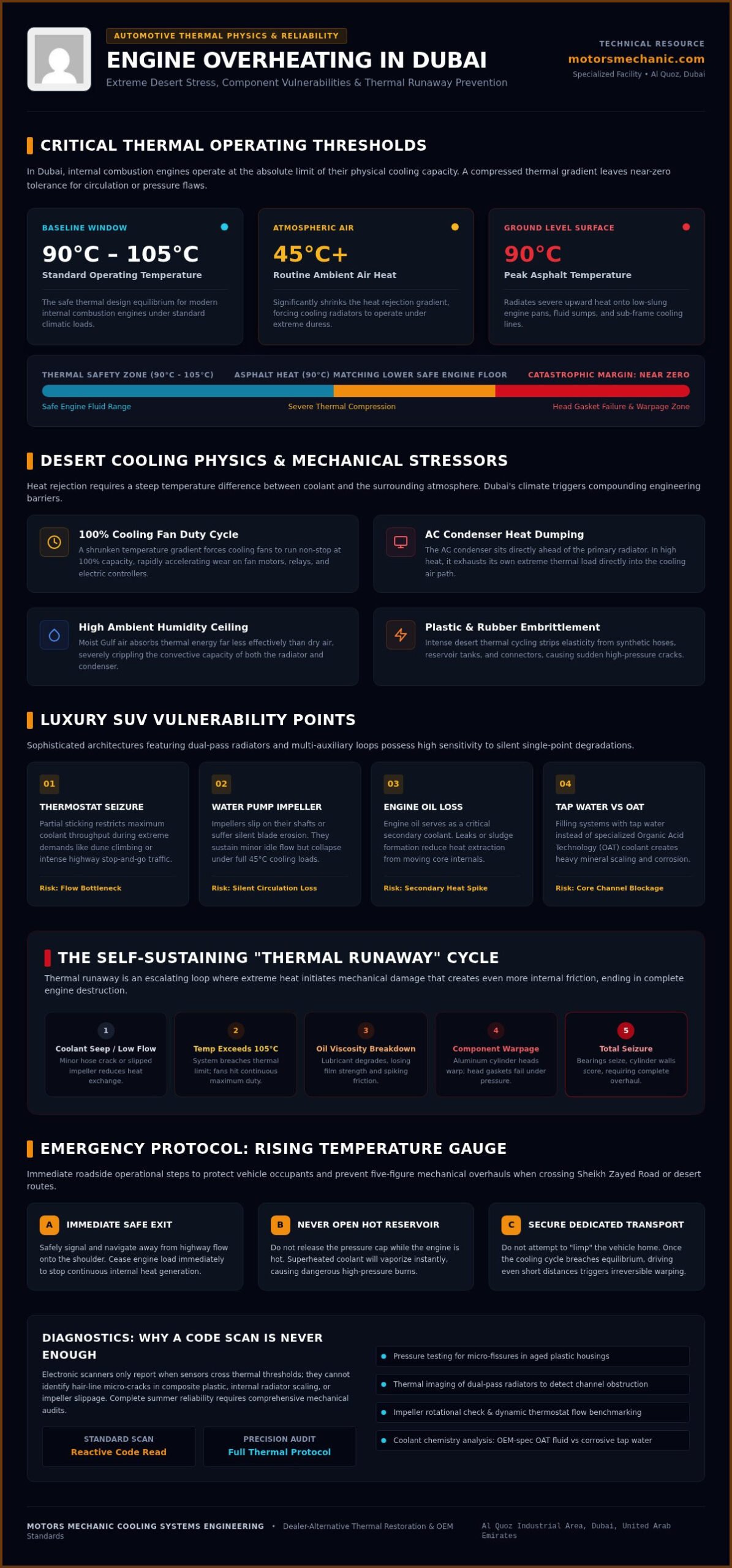
Overheating occurs when an engine exceeds its safe operating temperature, typically ranging between 90°C and 105°C. In Dubai, where ambient air temperatures routinely climb above 45°C and road surfaces can hit 90°C, your vehicle operates at the absolute edge of its thermal limits. This environment places immense pressure on internal combustion engine cooling principles, as the system must work significantly harder to reject heat into an already scorching atmosphere. A minor coolant seep that might be ignored for weeks in a temperate climate can escalate into a catastrophic failure within minutes on a Dubai highway. Prompt car overheating repair Dubai is essential to prevent a small leak from turning into a complete engine replacement.
High humidity levels further complicate this process. Moist air is less effective at absorbing heat, which reduces the efficiency of both the radiator and the AC condenser. Since the condenser usually sits directly in front of the radiator, it dumps its own heat into the air meant to cool the engine. This creates a “thermal ceiling” where the cooling system can no longer maintain a safe operating temperature, regardless of how fast you drive.
The Physics of Desert Cooling
The cooling process relies on a temperature gradient, which is the difference between the hot coolant and the outside air. When the ambient temperature is high, this gradient shrinks, forcing the engine’s cooling fans to run at a 100% duty cycle. This constant operation accelerates the wear on fan motors and relays. Additionally, the extreme heat cycles in the Middle East cause plastic cooling components and rubber hoses to become brittle. Over time, these parts lose their elasticity and crack, leading to sudden, high-pressure coolant loss that can strand you in dangerous conditions.
Consequences of Ignoring a Rising Temp Gauge
If you ignore a rising temperature gauge, the mechanical consequences are severe. Aluminum cylinder heads can warp, causing the head gasket to fail and allowing coolant to mix with engine oil. As the heat climbs, engine oil begins to lose its viscosity and breaks down, which increases internal friction and can lead to seized bearings or scored cylinder walls. You must act before the system enters a state of thermal runaway. Thermal runaway in automotive engines is a self-sustaining cycle where rising temperatures cause mechanical changes that generate even more heat, eventually leading to total engine destruction. Seeking professional car overheating repair Dubai at the first sign of trouble is the only way to avoid these five-figure repair bills.
Common Causes of Overheating in Luxury SUVs and Range Rovers
Luxury SUVs utilize sophisticated cooling architectures, often featuring dual-pass radiators and multiple auxiliary loops. While these systems are efficient, they’re highly sensitive to Dubai’s environmental stressors. A failure in a single sensor or a minor mechanical degradation can quickly cascade into a need for urgent car overheating repair Dubai. Understanding these specific failure points is the first step toward maintaining vehicle longevity in the desert.
The thermostat acts as a critical gatekeeper for your engine’s temperature. In high-load scenarios, such as climbing a dune or idling in heavy traffic, a partially seized thermostat prevents the rapid volume of coolant flow required to shed heat. Similarly, water pump impellers can fail silently. Unlike a total pump seizure, an impeller that has slipped on its shaft or suffered from blade erosion allows for some circulation but cannot meet the cooling demands of a 45°C afternoon. If you suspect a circulation issue, our specialists in Al Quoz can perform a precision cooling system audit to identify these silent failures before they cause permanent damage.
It’s also vital to consider the relationship between your engine’s fluid systems. Engine oil acts as a secondary coolant by absorbing heat from internal moving parts. If you’ve delayed an engine oil leak repair Dubai, the resulting low oil levels or sludge buildup significantly reduces the engine’s ability to manage its thermal load. This puts additional pressure on the primary cooling system, often pushing it past its breaking point.
Radiator and Coolant Reservoir Weaknesses
Using tap water instead of specialized OAT (Organic Acid Technology) coolant is a frequent mistake that leads to expensive repairs. The high mineral content in local water leads to calcium scaling, which clogs the narrow passages of a high-performance radiator. Furthermore, many luxury vehicles use radiators with plastic end-tanks. These components are prone to hairline fractures due to the extreme thermal expansion and contraction cycles common in the Middle East. Pressurized expansion tanks also serve as a weak point; a failing cap that can’t hold pressure will cause the coolant to boil at a much lower temperature than intended.
Electric Cooling Fan and Viscous Clutch Failures
Most modern SUVs rely on high-output electric fans, while some older models use mechanical viscous clutches. According to NHTSA vehicle maintenance guidelines for extreme heat, regular inspections of these components are vital for safety. A tell-tale sign of fan failure is an engine that overheats while idling in traffic but cools down once the vehicle is moving. This occurs because the fan can no longer pull enough air through the AC condenser and radiator. Since the AC condenser generates immense heat when running, a failing fan motor quickly leads to a dangerous heat-soak condition.
Diagnostic Process: Identifying the Root Cause of Engine Heat
A standard OBD-II code scan only tells a small part of the story. While a computer might flag a high coolant temperature error, it won’t reveal if a plastic hose flange has a hairline fracture or if your radiator is 30% clogged with desert silt. Effective car overheating repair Dubai requires a methodical, multi-step diagnostic process that goes beyond digital readouts. Technicians begin with a comprehensive visual inspection, looking specifically for pink, orange, or white crusty residue. This residue is the tell-tale sign of evaporated coolant, pointing directly to a slow leak that might only occur under high pressure.
Relying on a generic garage often leads to misdiagnosis. You can review AAA’s breakdown of car overheating causes and solutions for general context, but Dubai’s extreme heat demands specialized tools. A specialist must evaluate the entire cooling circuit rather than just the failed component. Fixing a burst hose without identifying the failing thermostat that caused the pressure spike only leads to another breakdown. Comprehensive diagnostics ensure that every vulnerability is addressed before you return to the road.
Pressure Testing and Combustion Leak Checks
To find hidden vulnerabilities, technicians perform a pressurized leak test. By applying 15 to 20 PSI to the system while the engine is cold, we force coolant through microscopic cracks that aren’t visible during normal operation. If the system holds pressure but the car still overheats, a block test is necessary. This chemical test detects CO2 in the expansion tank, confirming if combustion gases are leaking into the cooling system due to a compromised head gasket. We also utilize thermal imaging cameras to map the radiator’s surface. Cold spots on the thermal map indicate internal clogs or dead zones where coolant isn’t flowing, signaling that the unit requires restoration. This level of precision is vital for professional car overheating repair Dubai.
Evaluating the AC and Cooling Synergy
In the UAE, your engine cooling and air conditioning systems are inseparable. A failing AC compressor can put immense mechanical strain on the engine, raising its internal temperature rapidly. During a professional diagnostic at Motors Mechanic, we inspect the sandwich space between the AC condenser and the radiator. Sand, dust, and debris frequently collect here, creating a physical barrier that prevents airflow. Removing this debris is often as critical as replacing mechanical parts. Finally, we use specialized diagnostic equipment to monitor real-time sensor data, ensuring the electric fans trigger at the exact millisecond the ECU demands.
Emergency Steps: What to Do When Your Temperature Gauge Rises
When your dashboard displays a “High Engine Temp” warning, your reaction time determines whether you’ll need a simple part replacement or a total engine overhaul. On high-speed arteries like the E11 or Al Khail Road, safety is your first priority. Activate your hazard lights and navigate to the hard shoulder or the nearest exit immediately. If traffic prevents an instant stop, execute the “heater trick”: turn off your AC and blast the cabin heater on the highest fan setting. This uses the interior heater core as a secondary radiator to pull critical heat away from the engine block, potentially buying you the minutes needed to reach a safe refuge.
The most dangerous mistake a driver can make is opening the radiator or expansion tank cap. The cooling system is under intense pressure; releasing the cap on a hot engine can spray superheated steam and boiling fluid, causing severe facial or hand burns. You must wait at least 30 to 45 minutes for the system to cool naturally before attempting to inspect fluid levels. For a reliable resolution, professional car overheating repair Dubai is required to identify why the system failed under pressure.
Immediate Roadside Response
Once you’ve stopped in a safe location, turn off the engine immediately. Idling a hot engine without the benefit of airflow from driving will only accelerate mechanical damage. If it’s safe and there’s no visible fire, pop the bonnet to help trapped heat dissipate. Never pour cold water directly onto a hot engine block or into a dry radiator. The sudden temperature shock can cause the metal to contract rapidly, leading to hairline cracks or a completely shattered engine block. Let the engine reach a touch-safe temperature before you consider adding any fluids.
Assessing the Damage
Look for signs of catastrophic failure while you wait for a recovery vehicle. Visible steam or a large puddle of bright green, orange, or pink fluid under the car indicates a major hose or radiator breach. You can identify a coolant leak by a distinct, sweet, syrupy smell coming from the engine bay; this is the scent of ethylene glycol vaporizing on hot metal. If you see a “Coolant Level Low” warning alongside the temperature spike, the engine is likely dry. Restarting it for even 500 meters will cause metal-on-metal friction that results in a five-figure repair bill. In these cases, professional car overheating repair Dubai via a flatbed recovery to our facility is the only way to protect your investment.
Protect your engine from further damage by scheduling a professional cooling system inspection today.
Professional Cooling System Restoration at Motors Mechanic
Motors Mechanic stands as the definitive specialist for luxury car overheating repair Dubai. We recognize that luxury SUVs require more than just a quick fix; they demand a comprehensive restoration of their thermal management systems. By choosing us as your dealer alternative, you gain access to factory-level diagnostics and technical mastery without the institutional overhead. We utilize only OEM parts and high-specification coolants specifically formulated to withstand the high boiling points required for the UAE’s 45°C+ summer climate.
For owners of older models, we provide a dedicated Cooling System Overhaul. This service is designed to address the natural degradation of seals and plastic components before they fail. Our location ensures easy access for residents across Dubai, providing a centralized hub for specialized mechanical care that prioritizes technical precision over speed.
Range Rover Specialized Cooling Expertise
Range Rover vehicles, particularly those equipped with the Supercharged V8, feature complex cooling loops that require specialized knowledge to service correctly. These engines generate immense internal heat, and a single error in bleeding the system can lead to air pockets that cause localized hotspots. Our technicians are specifically trained in Range Rover thermal management, ensuring every auxiliary pump and valve operates within factory parameters. If your vehicle has already suffered from extreme heat, we offer comprehensive engine overhaul services to restore your vehicle to peak performance. We also handle specialized timing chain replacements if heat damage has compromised the engine’s internal timing components.
Preventative Summer Maintenance Packages
Don’t wait for a breakdown on the E11 to address your vehicle’s cooling needs. Our Summer Ready inspection package is a proactive solution designed to identify vulnerabilities before they become emergencies. This service includes a professional coolant flush, cooling fan duty-cycle testing, and a deep chemical cleaning of the radiator and condenser fins to remove desert silt. We strongly recommend proactive hose replacement for vehicles over five years old, as rubber components become brittle under the intense thermal cycles of the Gulf. Taking these steps now ensures your car remains reliable throughout the peak of the August heat.
Schedule your professional cooling system inspection at Motors Mechanic and secure your peace of mind for the summer season.
Secure Your Engine’s Thermal Resilience for the Dubai Summer
Driving in Dubai means operating your vehicle at the absolute limit of its cooling capacity. We’ve explored how extreme road temperatures and brittle plastic components turn minor leaks into mechanical emergencies. You now understand that professional car overheating repair Dubai involves more than just topping up fluids; it requires precision diagnostics and technical restoration. By addressing vulnerabilities like clogged radiators and failing thermostats early, you prevent the high costs associated with a total engine overhaul.
As a dedicated Range Rover Specialist Garage we utilize advanced engine diagnostic tools to identify silent failures before they strand you in the desert heat. Our team is ready to take charge and restore your vehicle’s reliability through technical mastery and high-quality craftsmanship. Don’t leave your safety to chance during the peak of the summer season. Taking proactive steps today ensures your engine remains dependable, no matter how high the temperature climbs. Book an Expert Cooling System Diagnostic at Motors Mechanic to safeguard your investment and enjoy total peace of mind on every journey.
Frequently Asked Questions
Is it safe to drive my car if the temperature gauge is slightly above normal?
No, you shouldn’t continue driving if the temperature gauge exceeds its normal operating range. In Dubai’s extreme heat, a “slightly high” reading can escalate to a total engine seizure in minutes. Pull over safely and shut down the engine to prevent warped cylinder heads. Continuing to drive risks a catastrophic failure that turns a minor repair into a complete engine overhaul at our workshop.
Why does my car only overheat when the AC is turned on in Dubai?
Turning on the air conditioning places a massive thermal load on your cooling system. The AC condenser, located directly in front of the radiator, releases intense heat that the radiator must then process. If your cooling fan is weak or the radiator fins are clogged with desert dust, the system can’t manage the extra heat. This synergy is why professional car overheating repair Dubai often includes an inspection of the AC system’s impact on engine temperatures.
How much does car overheating repair typically cost in Dubai?
The cost of car overheating repair Dubai depends entirely on the root cause and the extent of the thermal damage. A simple thermostat replacement is significantly more affordable than a full radiator restoration or a head gasket repair. We recommend a specialized diagnostic at Motors Mechanic to identify the exact failure point. This prevents you from paying for unnecessary parts while ensuring your luxury SUV remains reliable in the 45°C+ summer heat.
What is the difference between a coolant flush and just topping it up?
Topping up only replaces lost volume, whereas a coolant flush removes harmful mineral deposits and degraded fluid from the entire system. Over time, coolant loses its anti-corrosive properties and ability to transfer heat effectively. A professional flush ensures the internal passages of your engine and radiator are clear of scale. This is a critical preventative measure for any high-performance vehicle operating in the Middle East.
How often should I replace my car’s coolant in the UAE?
We recommend replacing your vehicle’s coolant every two years or every 40,000 kilometers, whichever comes first. Dubai’s intense thermal cycles cause chemical additives in the coolant to break down faster than they would in temperate climates. Using high-specification OAT or HOAT fluids is essential for protecting the aluminum components in Range Rover engines. Regular replacement prevents internal corrosion and maintains the system’s ability to withstand boiling under pressure.
Can a faulty car battery or alternator cause overheating?
Yes, a failing battery or alternator can lead to overheating in modern luxury vehicles. Many premium SUVs utilize high-output electric cooling fans and electronically controlled water pumps that require consistent voltage. If the alternator isn’t providing sufficient power, these components may run at a reduced duty cycle, failing to shed heat properly. Our diagnostics include a check of the electrical system to ensure your cooling hardware receives full power.
What are the signs that my head gasket is blown from overheating?
Common signs of a blown head gasket include white smoke from the exhaust, a milky appearance in the engine oil, and constant bubbling in the coolant expansion tank. You might also notice a significant loss of engine power or a sweet smell from the tailpipe. These symptoms indicate that combustion gases are entering the cooling system. If you detect these signs, stop driving immediately to avoid permanent block damage and contact a specialist for an engine inspection.
Why is my car losing coolant but there are no visible leaks on the ground?
If you’re losing fluid without puddles on the ground, the coolant is likely escaping internally or vaporizing. A faulty expansion tank cap can allow pressurized steam to escape unnoticed while you drive. Alternatively, an internal leak might be forcing coolant into the combustion chamber or the oiling system. We use specialized pressure testing and chemical block tests to locate these hidden leaks, ensuring a definitive car overheating repair Dubai that protects your engine.