
When your Range Rover blows warm air on a Dubai afternoon, the instinct is simple: search “car ac repair near me” and book the first available slot. That instinct can be an expensive mistake. The air conditioning system in a luxury European or American vehicle bears almost no resemblance to the unit cooling a standard economy car, and treating the two as equivalent is where costly misdiagnoses begin.
Modern luxury vehicles integrate their AC compressors directly into the engine’s electronic architecture, run proprietary refrigerants that standard workshops do not stock, and manage cabin temperature across multiple independently calibrated zones. A generic repair shop lacks both the diagnostic tools and the brand-specific knowledge to work within that complexity safely.
This analysis breaks down exactly what separates a luxury vehicle’s climate system from the norm. You will learn how ECU-linked compressors and CAN BUS communication work, why the wrong refrigerant destroys components, how multi-zone calibration differs from a simple recharge, and how to identify a specialist who can resolve the fault correctly the first time, without dealership pricing.
A Luxury Vehicle’s AC System Is Not What Generic Workshops Expect
In a standard economy or mid-range vehicle, the air conditioning system is largely mechanical: a belt-driven compressor, a condenser, an expansion valve, and a blower. A pressure check tells most of the story. Luxury platforms operate on an entirely different principle.
In a Range Rover, BMW, or Mercedes, the AC compressor is embedded within the vehicle’s electronic architecture via CAN BUS communication networks, the same high-speed data backbone that connects the engine, transmission, and safety systems. The compressor does not simply engage when refrigerant pressure drops. It operates through electromagnetic clutches and swash-plate variable displacement assemblies, with pressure sensors feeding live data directly to the Engine Control Unit. The ECU then governs compressor behaviour based on engine load, vehicle speed, ambient temperature, and cabin sensor inputs simultaneously.
A generic workshop running a standard pressure check on one of these systems sees only the refrigerant circuit. The electrical signals, sensor states, and software parameters governing compressor engagement remain entirely invisible without brand-specific diagnostic tools. That diagnostic blind spot does not produce a minor oversight; it produces misdiagnosis. Compressors that are functioning correctly get condemned. Components get replaced that were never at fault. In some cases, the intervention itself causes damage.
Dubai’s summer ambient temperatures, regularly exceeding 40°C, compound every layer of this complexity. Both thermal load and diagnostic margin narrow simultaneously, making accurate, architecture-aware diagnosis not a refinement but a requirement.
ECU-Linked Compressors: Why CAN BUS Integration Changes Everything
In a conventional car, the compressor engages mechanically when the driver selects cooling. In a Range Rover, BMW, or Mercedes, that decision belongs to the ECU. Compressor behaviour is governed by software logic: the Engine Control Unit processes cabin sensor readings, ambient temperature, vehicle speed, and engine load simultaneously, then commands engagement accordingly. A pressure gauge reads refrigerant state. It cannot interrogate any of these variables.
This is where CAN BUS integration becomes critical. The Controller Area Network allows every relevant sensor to report live data to the ECU in real time, enabling continuous compressor modulation rather than simple on/off engagement. When that network carries a corrupted signal or a sensor drifts out of range, the compressor behaves abnormally without any mechanical fault being present.
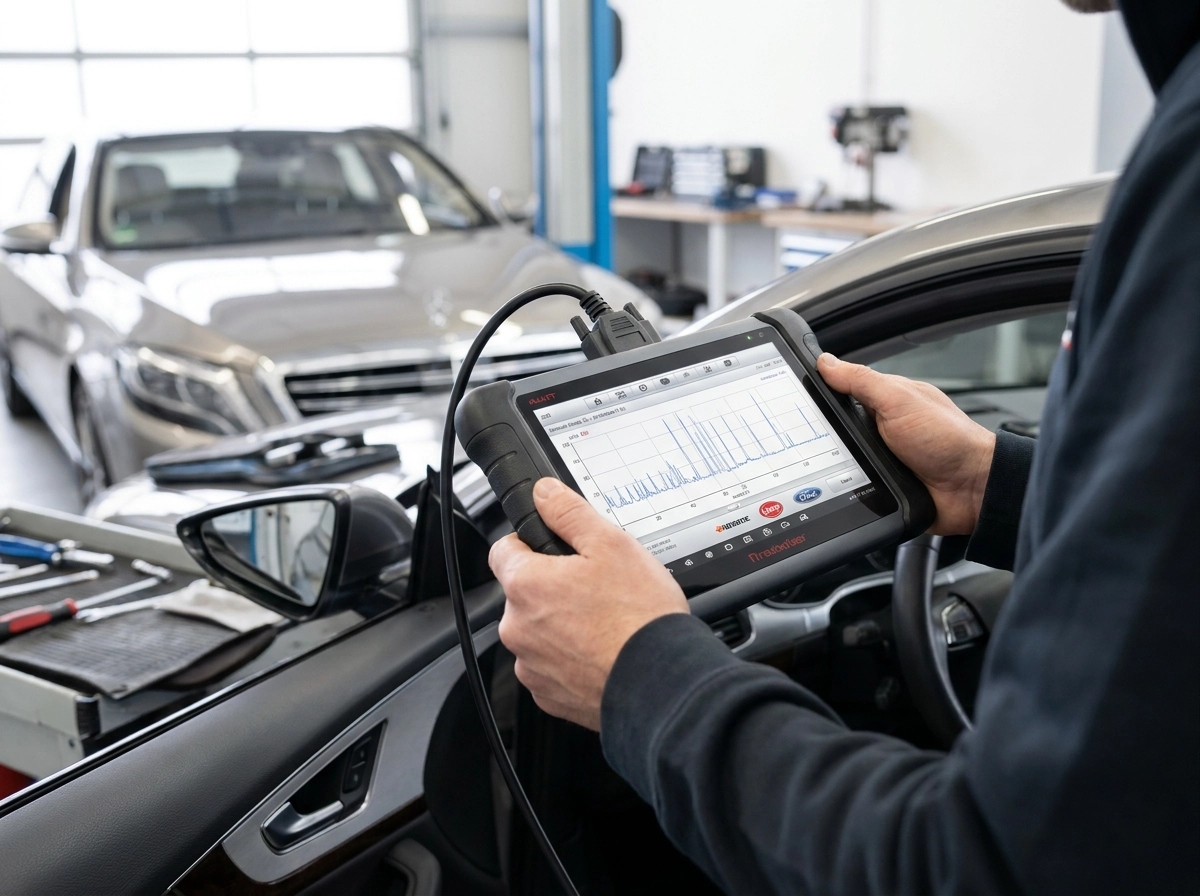
The diagnostic challenge this creates is significant. Three distinct fault types share nearly identical surface symptoms: electromagnetic clutch failure, swash-plate variable displacement error, and pressure sensor malfunction each produce insufficient cooling or erratic compressor cycling. The corrective action for each is entirely different. Only brand-specific diagnostic software, connected to the vehicle’s own CAN network, can distinguish between them by reading live ECU data.
Generic workshops without this capability routinely resolve the ambiguity by replacing the compressor. On a luxury platform, that component costs considerably more than the diagnostic fee a specialist would charge to identify a faulty sensor or a software calibration offset.
A specialist reads live ECU data and refrigerant pressures in parallel, determining whether the fault is mechanical, electrical, or software-driven before any part is touched. That sequence, data first, action second, is what separates a first-time fix from an expensive misdiagnosis.
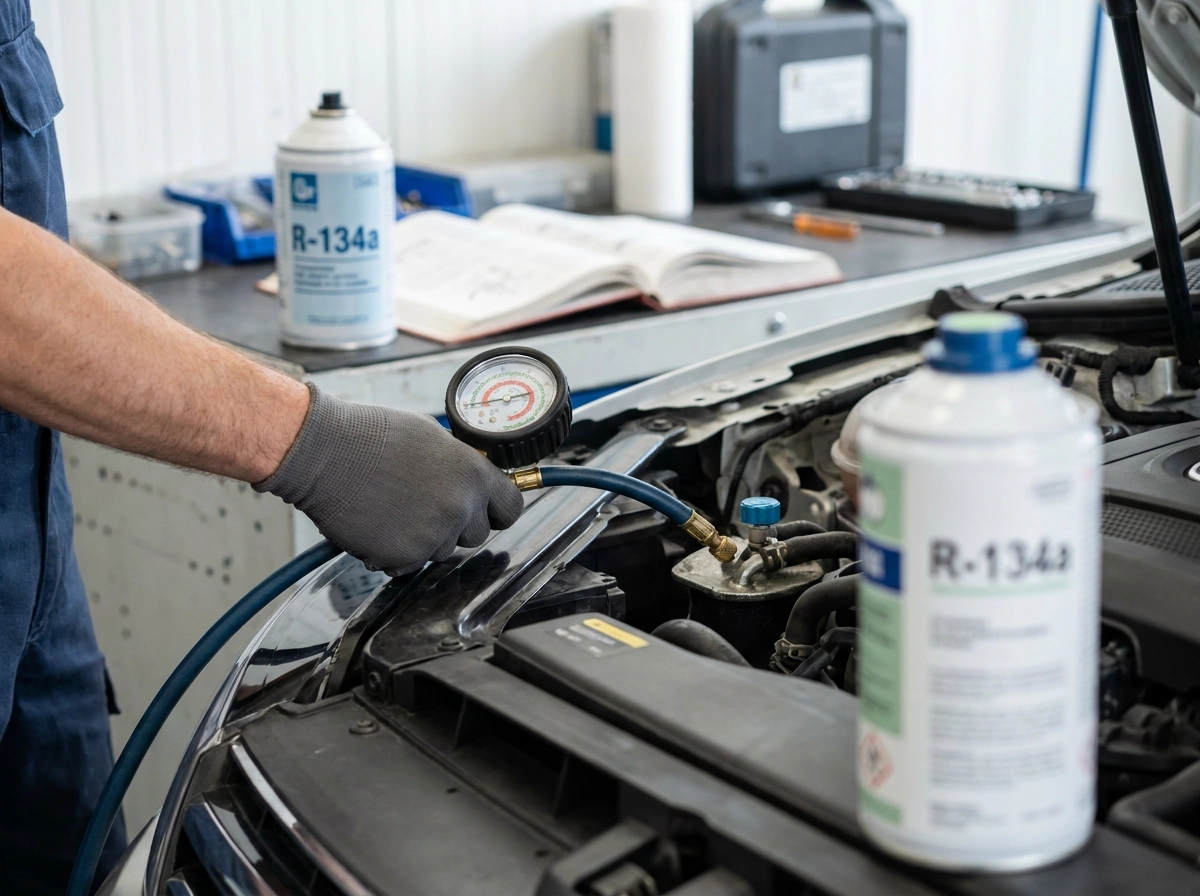
R-1234yf Refrigerant and Why the Wrong Fill Can Destroy a Compressor
Beyond the diagnostic software layer, refrigerant specification introduces a second failure point that generic workshops regularly get wrong.
Current-generation BMW, Mercedes-Benz, Audi, Porsche, and Range Rover platforms are engineered exclusively for R-1234yf refrigerant. R-134a, still common in older and economy vehicles, is not a compatible substitute. The two refrigerants carry different pressure characteristics, require different compressor lubricants, and have distinct material compatibility profiles with seals and hoses. Filling an R-1234yf system with R-134a does not simply reduce cooling efficiency; it degrades seals progressively, contaminates the lubricant circuit, and accelerates compressor wear in ways that may not surface until significant internal damage has already occurred.
Correct refrigerant type alone is not sufficient. According to MAHLE Aftermarket data, even properly filled AC systems lose up to 10% of their refrigerant annually under normal operating conditions. A system correctly charged at the last service interval may already be running below optimal pressure by the next visit. In Dubai’s summer ambient temperatures, which regularly exceed 40°C, an under-charged system works harder, runs hotter, and compounds compressor stress with every cycle. Over-charging carries equivalent risk; excess pressure causes thermal inefficiency and mechanical strain that accumulates over time.
Responsible R-1234yf servicing also requires certified recovery equipment to capture refrigerant before any repair begins. Many generic workshops in Dubai neither stock R-1234yf nor hold the certified handling equipment its use requires. A specialist workshop maintains an approved supply chain and compliant recovery infrastructure, ensuring the refrigerant circuit is serviced to OEM pressure specifications, not a generic approximation.
Multi-Zone Climate Control: Precision Calibration That Generic Shops Cannot Perform

Refrigerant type is only one layer of what separates a luxury climate system from a standard one. The architecture itself is fundamentally different.
A Range Rover, Mercedes, or BMW does not use a single thermostat and blower to condition the cabin. It uses independently controlled temperature zones, each governed by dedicated actuators, zone-specific sensors, and a climate-control module coordinating all of them through software. When the rear zone of a Range Rover stops cooling, or cabin temperature reads inconsistently across a Mercedes, the fault is rarely refrigerant pressure. It is more likely a blend door actuator fault, a zone sensor reading error, or a climate-control module configuration issue; none of these appear on a pressure gauge.
The correct resolution frequently involves software, not parts. BMW’s own technical documentation confirms that IHKA system temperature regulation faults across the G01, G30, and G12 platforms are caused by software errors in the climate-control unit, and that parts replacement will not resolve them. The mandated fix is reprogramming through BMW-specific diagnostic software. Mercedes multi-zone inconsistencies, Audi air distribution faults, and Range Rover rear-zone failures each follow distinct diagnostic pathways documented in specialist databases, none accessible through a generic scan tool.
A generic workshop encountering these faults will default to mechanical interventions because that is the limit of their diagnostic access. The result is repeat visits, replaced components that were never faulty, and symptoms that persist because the software root cause was never identified.
Thermal Management: When the AC and Engine Cooling Systems Are One
The complexity of multi-zone calibration sits within the climate system itself. What sits beneath it is more consequential: in modern luxury vehicles, the AC system and the engine cooling system share a single integrated thermal management architecture, coordinated by the ECU to balance engine temperature and cabin comfort simultaneously.
This is not two systems running in parallel. Coolant loops, temperature sensors, and compressor engagement logic are managed as a unified system. A workshop that recharges refrigerant without evaluating this wider loop may resolve the AC complaint while introducing a cooling deficiency under load, one that only surfaces when the engine is under sustained demand.
In Dubai, this matters more than in any temperate market. Ambient temperatures regularly exceed 45°C in summer, pushing both systems close to their thermal operating limits for extended periods. Any miscalibration in the shared management logic does not remain minor; it compounds quickly under those conditions.
There is a specific misdiagnosis pattern that follows from this. AC compressor engagement algorithms in European luxury platforms are written to protect the engine first. When coolant temperatures rise, the ECU can command the compressor to disengage to reduce engine load. Generic workshops frequently read this shutdown as a compressor fault and recommend replacement. The compressor was functioning correctly; the ECU was doing its job.
Comprehensive car AC repair service for these platforms requires evaluation of the full thermal management loop, not only the refrigerant circuit. That scope is the difference between a first-time fix and a recurring cycle of misdiagnosis.
What Comprehensive AC Diagnostics Actually Look Like for Luxury Vehicles
Understanding what a proper diagnostic actually involves clarifies why specialist capability matters so directly.
A complete assessment for a European luxury AC system covers vent temperature measurement, idle versus driving cooling performance comparison, cabin temperature consistency across all climate zones, refrigerant pressure analysis against OEM specifications, and airflow distribution through every outlet. These steps together establish whether the system is performing within manufacturer tolerances, not just whether cold air is present.
Compressor load evaluation must occur under real operating conditions. Static bay assessment cannot confirm whether compressor engagement behaviour matches ECU-commanded parameters; only live data captured through brand-specific diagnostic software, while the compressor is actually under demand, provides that confirmation.
HVAC module fault codes are stored separately from the engine ECU. Luxury vehicles log climate-specific diagnostic trouble codes in dedicated HVAC control units. A generic OBD reader interrogates the engine ECU and misses this data entirely, leaving faults invisible that a brand-specific tool reads immediately.
Road testing under load is non-negotiable. Many faults in luxury AC systems only appear at operating temperature, highway speed, or under full compressor demand. A workshop-bay pressure check replicates none of those conditions and will not surface intermittent or load-dependent failures.
On service frequency, MAHLE Aftermarket recommends an AC check every 12 months and a full AC service every two years for passenger vehicles. For luxury vehicles running year-round in Dubai’s heat, following that schedule at a specialist workshop is the most effective measure against compressor damage before it develops.
Specialist Workshops vs. Dealerships: The Cost and Quality Equation
Once the diagnostic picture is complete, the question becomes where to act on it, and the answer has a direct financial dimension.
Dealership service centres deliver OEM-compliant repairs, but their pricing reflects showroom overheads, franchise fees, and administrative structures unrelated to the repair itself. Factory-trained specialist workshops achieve approximately 30% savings against dealership pricing while maintaining equivalent diagnostic accuracy and OEM-grade parts compliance.
The more consequential comparison is between a specialist and a generic workshop. The risk of a generic workshop is not the service fee; it is what follows a misdiagnosis. An unnecessary compressor replacement on a BMW or Range Rover typically costs several times the original diagnostic fee, eliminating any saving on the booking and introducing new risk to components that were functioning correctly.
First-time fix rate is the metric that separates these tiers. A specialist who understands a brand’s climate architecture resolves the fault on the first visit. A generic workshop may cycle through multiple return visits, then escalate to a dealership anyway, leaving the owner having paid twice and lost time.
Motors Mechanic covers European and American premium vehicles including Range Rover, BMW, Mercedes, Audi, Porsche, Jaguar, Maserati, Bentley, Rolls-Royce, Volkswagen, Cadillac, GMC, Dodge, and Jeep, providing multi-brand diagnostic capability for complex climate systems under one roof in Dubai.
For owners researching car AC repair in Dubai or weighing auto repair options for a luxury vehicle, the specialist model combines independent workshop pricing with brand-authorised technical standards. Further context on evaluating garages and service costs is covered in this complete guide to vehicle repairs and maintenance in Dubai.
Common AC Fault Patterns by Brand in Dubai’s Climate
Brand architecture shapes where faults appear, not just how severe they are. In Dubai’s climate, each platform follows a predictable failure pattern that generic diagnostics consistently misread.
BMW (IHKA systems): Cabin temperature fluctuation is typically traced to sensor drift or module calibration issues within the IHKA system, not refrigerant loss. A pressure check returns normal readings; the fault remains unresolved. Correct diagnosis requires BMW-specific protocols that read IHKA module data directly.
Mercedes-Benz (S-Class, E-Class, GLE): Rear-zone cooling failures commonly involve blend door actuator faults or rear evaporator blockages. Dubai’s dust-laden air accelerates evaporator contamination, restricting airflow progressively rather than causing sudden failure, making the degradation easy to misattribute.
Audi and Volkswagen: Flap motor failures produce uneven airflow across zones. Replacing the motor alone does not resolve the fault; actuator recalibration through VCDS or equivalent software is required after every replacement, a step generic workshops routinely omit.
Range Rover and Land Rover: Large cabin volumes place disproportionate demand on rear-zone cooling. Above 40°C, rear evaporator performance degrades faster than the front circuit, requiring both mechanical inspection and software evaluation. This is covered in the complete guide to vehicle repairs and garage selection in Dubai.
Porsche, Maserati, and Bentley: Minor refrigerant pressure deviations trigger compressor protection modes. Generic scan tools report these shutdowns as compressor failures. Only live ECU data interpreted through specialist software distinguishes a protection-mode event from genuine hardware damage, determining whether the compressor is replaced unnecessarily.
Choosing the Right AC Repair Service for Your Luxury Vehicle in Dubai
The brand-specific fault patterns above share a common thread: none are diagnosable without the right tools. Before authorising any car AC repair on a European or American luxury vehicle, confirm that the workshop holds brand-specific diagnostic capability, not simply a generic OBD scanner. The distinction determines whether the root cause is found or merely guessed at.
If your vehicle is a post-2017 European luxury platform, verify that the workshop stocks R-1234yf refrigerant and operates certified recovery equipment. Using the wrong refrigerant degrades seals and contaminates lubricant; a workshop that cannot demonstrate compliant handling of R-1234yf should not be servicing your system.
Maintenance timing matters independently of symptoms. Schedule an AC check every 12 months and a full service every two years. Refrigerant loss of up to 10% annually is normal even in a correctly functioning system; the losses are cumulative, and a system that feels adequate today may be placing measurable stress on the compressor by next summer.
When a fault does appear, treat it as a diagnostic problem before a parts problem. A specialist who reads live ECU data prior to replacing any component will consistently cost less than a generic workshop that replaces a compressor to resolve what is actually a sensor fault.
For comprehensive guidance on maintaining premium vehicles in this market, Motors Mechanic offers brand-specific AC diagnostics, OEM-compliant refrigerant handling, and multi-zone climate expertise across the full range of European and American premium vehicles serviced in Dubai.
Conclusion
Luxury vehicle AC systems demand more than a refrigerant top-up and a visual inspection. They require brand-specific diagnostics, certified refrigerant handling, and calibration expertise that generic workshops simply cannot provide.
The key takeaways are clear: ECU-integrated components must be read with proper diagnostic tools, not guessed at. R-1234yf systems require compliant equipment and trained technicians. Multi-zone climate control demands precision calibration. And proactive maintenance prevents compressor damage before Dubai’s summer heat makes it unavoidable.
Your vehicle represents a significant investment. Protecting that investment means choosing a specialist who understands the engineering behind it, not one who treats every AC fault as a parts replacement opportunity.
Book a specialist AC diagnostic today. The right expertise costs less in the long run, keeps your system performing as engineered, and ensures your comfort through every season Dubai delivers.